.svg)


Get in Touch
Recent posts





 Jayakrishna Pai, Director - Kreston Menon
It is a familiar assumption in audit conversations – and one that continues to shape expectations across clients and engagement teams. With tighter reporting deadlines and increasing regulatory scrutiny, it can feel like speed and quality are fundamentally at odds.
 Meghna Mehta, Transfer Pricing Specialist - Kreston Menon
Transfer pricing is often misunderstood as a “large multinational” issue. In reality, it is a structural requirement that applies to any group with controlled transactions regardless of size.
 Vivek Muralidharan, Valuation & Financial Advisory - Kreston ME Consulting
Most businesses don't have a data problem. They have an interpretation problem.
A CEO sits down with the monthly report. Revenue is up. Overheads look flat. Margins are roughly where they were last quarter. The meeting wraps in twenty minutes.
 Kreston Menon
The UAE Federal Tax Authority (“FTA”) has issued a Public Clarification on the meaning of “director” and “officer” under the UAE Corporate Tax Law — an important development for businesses assessing Connected Person transactions under Article 36.
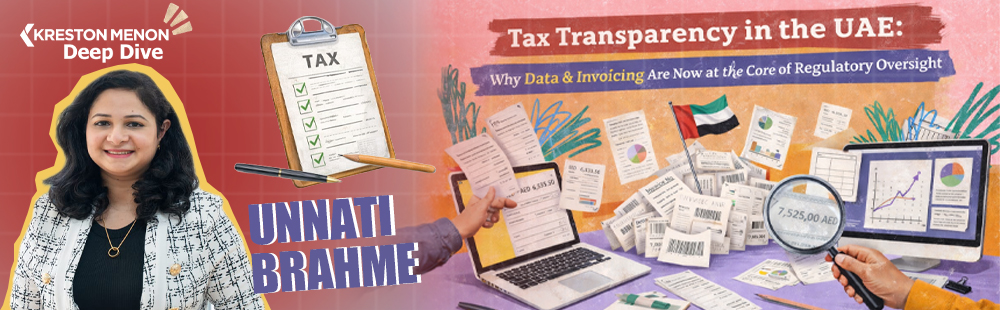 Unnati Brahme, Senior Tax Associate - Kreston Menon
The UAE’s tax landscape has moved decisively beyond its initial adoption phase and is now entering a stage of data-driven maturity.
 Anjali Mohan, Project Management Officer - Kreston ME Consulting
Think back to the last time a partner or service provider truly impressed you. Chances are, it was not a grand, choreographed gesture. It was likely something small: a proactive message when you least expected it, a specific detail they remembered from a previous conversation, or the grace with which they handled an unexpected hurdle.




