.svg)


Get in Touch
Recent posts



 Rich Howard, Chairman of Kreston Board
 Sudhir Kumar, Senior Partner & Head of Corporate Communications - Kreston Menon and Director - Kreston Global Board
The Middle East economy is still attracting inward investment in 2023, despite a slowing global economy. The IMF and World Bank are predicting GDP growth in the Middle East and North Africa (MENA) in 2023 to land somewhere between 2.4% and 3.1%.
 Ravishanker V, Director - Taxation, Kreston Menon
A critical one-time choice in the first CT return is whether to elect the “realisation basis” for unrealised gains and losses. Under normal accrual accounting, certain assets or liabilities can have unrealised gains or losses (for example, a rise in value of an investment property or securities portfolio) that are recorded in profit before any actual sale or settlement. By default, such unrealised gains would be included in accounting income and thus taxable.
 aravindmenon, Operations Manager - Kreston Menon
 Jenny Reed, Director of Quality and Professional Standards - Kreston Global
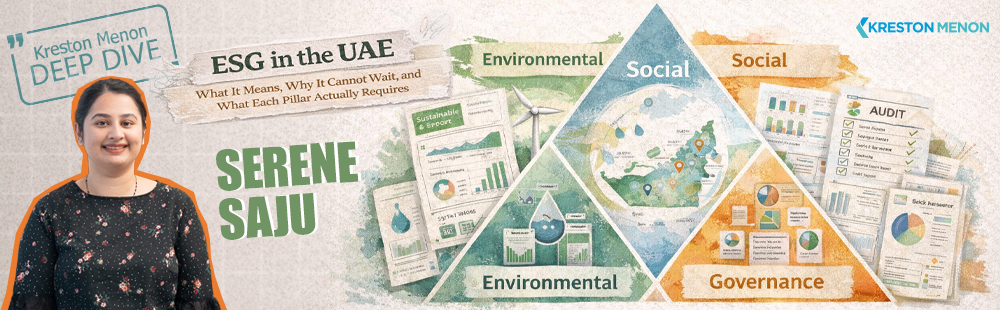
The degree to which environmental, social, and governance (ESG) reporting is being talked about depends very much on where you are in the world. The United Arab Emirates (UAE) has been somewhat of a trailblazer within the Middle East region when it comes to ESG:
- The UAE’s Securities and Commodities Authority issued guidance back in 2020 which mandated listed companies on the Abu Dhabi Securities Exchange (ADX) or Dubai Financial Market (DFM) to disclose ESG information in their annual report.
- In January, President His Highness Sheikh Mohamed bin Zayed Al Nahyan declared 2023 to be the “Year of Sustainability”.
- COP28 will be held in Dubai towards the end of this year, only the second time that the conference has been held in the Middle East.
- The UAE is the first Middle East and North Africa (MENA) nation to declare a strategic initiative to reach Net Zero by 2050.
ESG reporting is a challenge both for companies and firms of accountants. The increase in the volume of information that must be captured and reported on and, in due course, assured, is vast, and differs significantly from company to company depending on their industry sector and how they operate.
This can be even more difficult for smaller companies, many of which will get caught by ESG disclosure requirements despite them not being directly applicable to such companies yet in most jurisdictions. This is due to the concept of supply chain disclosures e.g. Scope 3 emissions for greenhouse gases, where a company has to disclose the CO2 emissions that it is indirectly responsible for up and down its value chain. Smaller companies will soon find themselves being asked for ESG data by their listed company customers, and most are simply not yet geared up to measure, capture, and analyze all the data that will be requested.
A further challenge is the lack of global standards for ESG reporting, resulting in a fragmented approach across the world (often known as the “alphabet soup”) which makes the situation even more difficult for companies within global operations and supply chains. However, this is now starting to change.
The formation of the International Sustainability Standards Board (ISSB) was announced at COP26 in Glasgow just two years ago. In that short time, a new international standard setting body has been set up to develop global sustainability disclosure standards that are backed by the G7, the G20, the International Organization of Securities Commissions (IOSCO), the Financial Stability Board, and numerous countries’ finance ministers and central banks.
Its work culminated in the release of the ISSB’s inaugural two sustainability standards on 26 June 2023:
IFRS S1 General Requirements for Disclosure of Sustainability-related Financial Information
The objective of S1 is to require an entity to disclose information about its sustainability-related risks and opportunities that is useful to users of general purpose financial reports.
IFRS S2 Climate-related Disclosures
S2 is focused on climate-related risks and opportunities.
We now have the first standards that will provide a global baseline for sustainability-related disclosures. These have been designed to work alongside financial reporting standards to enable seamless financial and sustainability reporting in the same reporting package. The two standards have been built on and consolidate the Task Force on Climate-Related Financial Disclosures (TCFD) recommendations, the Sustainability Accounting Standards Board (SASB – now part of the ISSB) standards, the Climate Disclosure Standards Board (CDSB) Framework, Integrated Reporting Framework and World Economic Forum metrics to streamline sustainability disclosures.
It’s early days, but the hope is that a consensus will form, and a majority of countries will choose to adopt the new ISSB standards over the coming years. The speed at which this will happen will vary considerably though in different jurisdictions. For example:
- Progress in the USA is strongly linked to the results of the next presidential election, due to be held in 2024.
- The EU forged ahead with its own ESG reporting framework, the European Sustainability Reporting Standards (ESRS). In its recent response to the EU consultation on the ESRS, IFAC noted: “significant concerns regarding the need for interoperability that supports a global system for reporting”. The European Commission and ISSB are continuing to work together to close the gap, but in the meantime, some substantial differences between the two will cause issues for many international companies that have operations in the EU.
One of the biggest challenges of ESG and sustainability reporting is the move to what is known as an “integrated mindset”. To deliver useful information for both internal decision-making as well as for external investors and wider stakeholders, many organizations are looking to break down functional and information silos, with a view to taking a holistic approach to both financial and sustainability information from within an organization and from outside.
This is something that is high on the corporate agenda at the moment, with IFAC president Kevin Dancey raising this in his presentation to the Forum of Firms in New York in June. This was also the topic of a recent conference I attended in Frankfurt, where academics, standard-setters, regulators, the accounting profession, and the business community got together to explore some of the practical challenges of taking such an approach.
The other aspect of ESG and sustainability reporting that affects the profession is the provision of assurance, and as with reporting, the situation is fragmented. The closest international standard we currently have is the ISAE 3XXX series:
- ISAE 3000 covers the provision of assurance other than audits or reviews of historical financial information, but is not specific to ESG and sustainability, and so is somewhat generic for this purpose and lacking in guidance on critical matters.
- ISAE 3410 only covers greenhouse gas emissions, and so is too narrow in scope on its own.
In the absence of anything better, most auditors have been muddling through using the above two standards. However, ESG assurance is an area where other third-party specialists outside of the accounting profession have also been providing services, using a variety of other assurance standards such as AA1000 and ISO14064. These vary considerably in terms of the amount of work to be performed and the level of assurance provided.
Fortunately, the International Auditing and Assurance Standards Board (IAASB) is coming to the rescue. It is currently working on a new sustainability assurance standard which will be known as ISSA 5000. Work has been progressing at a great pace compared to the usual time taken to draft a brand new standard, and the IAASB approved the first draft for public consultation at its recent meeting in June, with the aim of releasing the final version in September 2024.
Whilst this has been going on, the International Ethics Standards Board for Accountants (IESBA) has been running its own project, looking at ethical and independence issues affecting the provision of sustainability assurance engagements. The current plan is for a new Part 5 to the IESBA Code of Ethics which will apply to both limited and reasonable assurance engagements of sustainability information. The drafting will be such that it will be applicable to all sustainability assurance practitioners, both professional accountants and others.
ESG and sustainability reporting and assurance represent the biggest changes to the accounting and auditing professions for a generation. Within Kreston Global, our ESG Advisory Committee supports Kreston member firms in helping clients on their ESG journey. We can all play our part in moving towards a more sustainable world. His Highness couldn’t have put it better: “Today for Tomorrow”.
 Gulf News
Demand Runs High for Auditors, With More Corporate Tax Focused Firms Set For Launch
If anyone asks about the job category with the fastest and highest hiring rates in the UAE, don’t look beyond tax auditors and specialists. The hiring process continues even as the UAE Corporate Tax formally launched on June 1, with industry sources saying there are still more positions to be filled.
Where they are not getting filled internally, businesses are contracting those tasks to outside audit firms, which are expanding their own workforce to cope with the demand rush.
At the manager level, the salary structure for a tax auditor would vary between Dh18,000 to Dh24,000 a month depending on the firm.
Entry level salaries and incentives too have improved in the last 6-8 months, while candidates are lining up 10-25 per cent increases in their take-homes when they make the jump to a new employer.
Hiring in ‘Surge’ Mode
So, is hiring of tax auditors in ‘surge’ mode? Shibu Abraham, Director – Human Resources at the consultancy Kreston Menon, stops short of saying that a surge is on.
“There is demand for qualified and experienced tax consultants and auditors,” he said. “We have seen an increase of 10 percent in our staff strength this year, mostly at entry and mid-level.
“We have a structured career path for auditors, where most of them join as trainees or associates and who over time get promoted to senior auditors, supervisors and managers.”
Audit industry sources say that more specialist tax firms will launch in the coming weeks, and they too will get onto the hiring spree.
“Not every business can afford to have an in-house team of tax specialists, which is why outsourcing offers a big opportunity,” said an auditor.
“These new businesses are either launching on their own and hope to gradually build up a clientele, or opt for joint ventures to speed up the process.”
“Companies are increasingly outsourcing their tax functions to external tax consultants or firms,” said Abraham. “This approach is prevalent among many businesses, especially SMEs that might not have the resources or expertise to handle complex tax matters in-house.”
– Shibu Abraham, Director – Human Resources at Kreston Menon
More Graduates Enter the Fray
It’s also a good time for new tax professionals to seek their chances in a trending job market. This week, Dubai’s DIFC Academy saw the passing out of the first 28 candidates who went through the UAE Corporate Tax Diploma Programme, run in tandem with PwC Middle East. Some of them had already passed the Final Certificate Examination provided by ATT-UK.
Focus on Awareness
At the DIFC Academy, they went through a ‘condensed’ 30-day programme that equips them ‘to guide companies in complying with the new UAE corporate tax requirements’.
That’s exactly what the market wants.
“Finance professionals have gained the practical knowledge and skills to successfully ensure that all practices, systems, and processes of their respective companies comply with the new tax regime,” said Christian Kunz, Chief Strategy, Innovation and ventures Officer at DIFC Authority.
Everyone’s Hiring
“The Big 4 and other top accounting firms are looking for qualified and experienced auditors and tax consultants who can combine tech know-how with their finance and taxation skills,” said Abraham.
“We had seen many individual tax consultants moving to the UAE to capitalize on the opportunities thrown open by the introduction of VAT a few years ago. We have also recently seen the emergence of tax boutique firms.
”Other industry sources say that the current buzz around hiring tax professionals far exceeds anything during the launch of the VAT regime in 2018.
“It will be no exaggeration to say that tax professionals are among the most active when it comes to registering for UAE’s Golden Visa program,” said a consultant. “The rush is unprecedented.”
Is Every UAE Business Up To Speed On Tax?
Registering for the corporate tax UAE continues apace, but there is still time to start the process towards tax filings and making sure the books are in order.
“Companies are increasingly outsourcing their tax functions to external tax consultants or firms,” said Abraham. “This approach is prevalent among many businesses, especially SMEs that might not have the resources or expertise to handle complex tax matters in-house.”
This is why ‘to attract and retain the right talent, there is always a cost involved.”
It’s all showing up in the frenetic hiring in the UAE for auditors. Particularly those who specialise on tax matters.
Source: “More jobs, salary hikes: Is UAE’s demand boom for tax professionals only getting started? ’” by Manoj Nair, Business Editor, Business Section, Gulf News newspaper, 23 August 2023 and online article here.




