.svg)


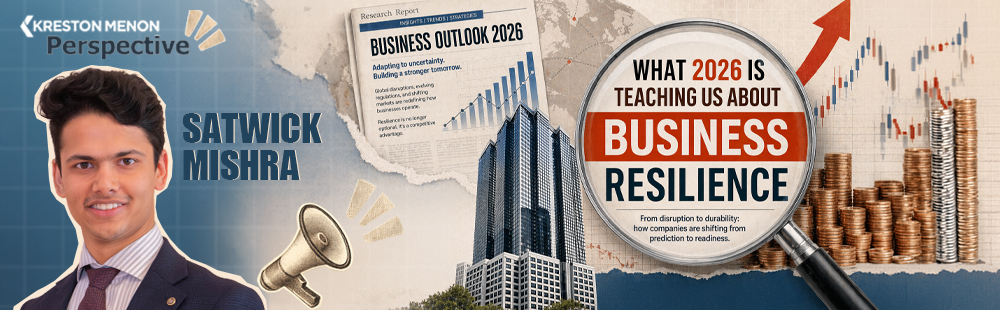
What 2026 Is Teaching Us About Business Resilience
 Satwick Mishra, Corporate Tax Consultant - Kreston Menon
Over the past few years, disruption has quietly become part of how businesses operate - a direct result of which is businesses having to learn how to function in an environment where uncertainty is the only certainty.
At the start of the year, many businesses were still asking familiar questions. Where are markets headed? How will regulations evolve? What risks should we be preparing for? But, as the year has progressed, the focus has started to shift. Businesses stopped asking whether disruption was coming and started asking whether they were built to handle it. In other words, lesser emphasis is being placed on predicting the future, and more on being ready for it.
That change in framing matters more than it might seem.
A large part of this shift is being shaped by the broader global environment. Geopolitical tensions have continued to impact trade flows, supply chains, and business confidence.
Around 20 percent of global oil supply passes through the Strait of Hormuz, making any disruption in the region immediately felt across global markets. Recent developments have also led to some upward pressure on energy prices and raised concerns around supply stability, with global institutions noting potential risks. These disruptions are not isolated.
Rising uncertainty has translated into higher freight costs and longer delivery timelines across key trade routes, creating ripple effects for businesses well beyond the immediate region.
Closer to home, businesses in the UAE have felt these pressures in different ways.
While the economy remains resilient overall, recent business surveys suggest that non-oil private sector growth has moderated compared to previous highs, reflecting a more cautious operating environment.
Businesses across sectors have felt the impact in different ways. Many have faced rising costs and occasional delays, while others have seen shifts in demand and planning challenges. Even in industries where operations remain steady, increased cost pressures and less predictable timelines are becoming more common.
And yet, despite these challenges, there is a sense that businesses are better prepared than they were a few years ago.

Businesses demonstrating Resilience
A big part of the preparedness is being shaped from past experience. As His Highness Sheikh Mohammed bin Rashid Al Maktoum has said, “Failure is not falling to the ground; it is remaining there once you have fallen and the greatest failure is when you decide not to stand up again.”
At the height of the pandemic, global supply chains broke down in ways that exposed real vulnerabilities in sourcing, cash management, and operational flexibility. Today, those lessons are being implemented to develop more resilient strategies. Diversifying suppliers, building cash buffers, and adopting more flexible operating models are no longer reactive measures, but have instead become part of standard business strategy.
A few practical patterns stand out from what this year has shown so far and from what we have seen in our own work.
First, resilience today is less about prediction and more about flexibility. The businesses adapting best are not trying to get every forecast right. They are building systems that allow them to respond quickly when conditions change.
Second, staying close to the numbers has become critical. Clear visibility over cash flow, costs, and margins is helping businesses make faster and more confident decisions in uncertain environments.
Third, technology is proving most valuable when it is applied with intent. While adoption has increased across the board, the real value is coming from targeted use cases that improve efficiency, strengthen decision-making, and reduce operational risk.
Finally, strong fundamentals continue to matter. Internal controls, governance, and disciplined planning may not always be visible, but they provide the stability businesses need when external conditions are unpredictable.
What is worth noting is that resilience is not limited to the largest organisations. In many cases, it is the businesses making consistent, practical decisions over time that are navigating uncertainty the best.
In many ways, 2026 is reinforcing a simple idea.
Stability does not come from certainty. It comes from preparedness.
For businesses willing to adapt, the current environment is not just a challenge to manage. It is a chance to build something more durable.