.svg)


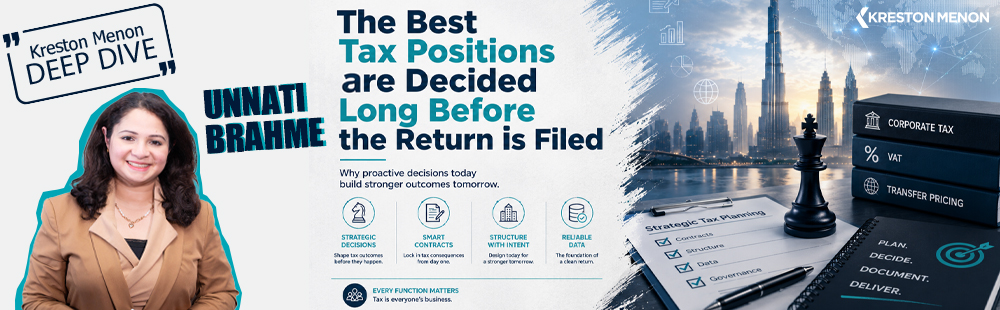
The Best Tax Positions Are Decided Long Before the Return Is Filed
 Unnati Brahme, Senior Tax Associate - Kreston Menon
For most organisations, tax only commands boardroom attention as the financial year draws to a close. Reconciliations are run, adjustments reviewed, and the Corporate Tax return is filed against a hard deadline. It is a natural rhythm — but it quietly reinforces a misconception: that tax is something a business does at year-end, rather than something it has been doing all along.
The return itself settles nothing. It simply documents a position that was already locked in, months earlier, through ordinary commercial life.
A Corporate Tax return does not create a company's tax position — it certifies one that already exists.
Consider a straightforward example: a business negotiates a three-year distribution agreement with a related entity overseas. The pricing, payment terms and delivery obligations are finalised long before anyone in finance reviews the arrangement for Transfer Pricing purposes. If the terms don't hold up to an arm's-length standard, there is no elegant fix at filing time — only a difficult conversation with the regulator, or an expensive re-negotiation. The moment of real influence was the negotiation itself, not the tax computation.
This is the shift underway across the UAE's evolving regulatory landscape. Tax has moved from a year-end compliance task to a live input into governance, risk appetite and commercial strategy.
Strategy Generates Tax Consequences Before Finance Ever Sees Them
Tax outcomes are rarely engineered by the finance function. They are the by-product of ordinary business activity — market entry, pricing strategy, procurement terms, financing choices, and digital investment.
Each of these carries consequences that surface later: where an activity is deemed to take place, how a transaction should be classified, when revenue is recognised. None of this is abstract. A logistics company launching a new UAE warehouse, for instance, is really making decisions about permanent establishment exposure and VAT place-of-supply rules — whether anyone frames it that way or not.
Effective tax planning happens upstream of execution, embedded in the conversations where a deal is still being shaped — not downstream, where all that remains is to record what already happened.
Contracts Are Tax Instruments in Commercial Disguise
A contract is negotiated for pricing, service levels and risk allocation. What often goes unnoticed is that the same document simultaneously fixes the tax treatment of everything that follows from it.
Payment mechanics, delivery terms, revenue-recognition clauses and cross-border provisions determine how a transaction is read for VAT, Corporate Tax and Transfer Pricing purposes alike — frequently all three at once, from a single invoice. Once signed and operational, an agreement is rarely something a business can quietly unwind. A clause overlooked in March can surface as an exposure eighteen months later, at audit.
Bringing tax expertise into the room while terms are still being drafted — rather than the filing cabinet — is the difference between a manageable observation and a costly correction.
Structure Should Be Engineered, Not Repaired After the Fact
Growth forces decisions about legal entities, operating models and where functions sit. A new market, a centralised shared-services hub, a group reorganisation — these are framed as commercial choices, yet each one also fixes the tax and reporting obligations a business will carry for years.
Retro-fitting a structure after expansion has already occurred is consistently costlier and less flexible than designing one properly from the outset. A holding structure assembled hastily to close a deal, for example, often becomes the very thing that complicates a future exit. Structure deserves the same forward planning as the deal itself.
Reliable Data Is the Real Foundation of a Clean Return
Complexity at year-end rarely originates in the tax calculation. It comes from patchy records, inconsistent postings, and documentation nobody maintained in real time — leaving teams to spend weeks reconstructing history instead of interpreting it.
A well-structured chart of accounts, consistent policies, dependable ERP data and methodical record-keeping aren't finance housekeeping; they are the infrastructure tax reporting is built on. As the UAE moves toward near-real-time, e-invoicing-driven scrutiny, this infrastructure stops being optional. A return is only as credible as the data supporting it — and increasingly, regulators can verify that data faster than a business can explain it.
Ownership Extends Well Beyond the Finance Department
Perhaps the most overlooked truth in tax governance is how many functions actually shape the outcome. Legal drafts the obligations. Procurement sets supplier terms. Sales fixes pricing. Operations design the supply chain. HR structures compensation. Technology builds the systems that capture it all.
Each function makes calls that ultimately land on the tax return, whether or not anyone in that function thinks of their work as "tax." Organisations that build cross-functional awareness catch implications while a deal can still be adjusted — not six months later, in a regulator's information request.
Governance Has Become a Commercial Asset — Without Anyone Announcing It
Governance is still widely treated as a defensive requirement. Its real value runs deeper. Clear approval trails, documented rationale and consistent record retention allow a business to respond to a regulatory enquiry in days rather than weeks, with minimal disruption to operations.
More importantly, strong governance gives leadership the confidence to move quickly on commercial opportunities, unburdened by unresolved compliance risk. As regulatory review becomes more continuous and data-driven, that confidence is turning into a genuine point of differentiation between competitors.
The Return Is a Mirror, Not a Starting Point
The introduction of Corporate Tax in the UAE has pushed businesses to tighten their compliance processes — a necessary and welcome shift. But the organisations extracting the greatest value from it are those treating tax as a discipline woven into daily decisions, not an annual filing ritual.
The strongest outcomes are never produced by a clever year-end adjustment. They are built earlier — through well-negotiated contracts, deliberately designed structures, dependable data and genuine cross-functional collaboration.
A Corporate Tax return does not determine where a business stands. It reflects the cumulative weight of decisions already made, month after month, deal after deal.
The real question for any leadership team, then, isn't "was the return filed correctly?" It's "were the decisions behind it made with tax in the room?"
Organisations that can answer “yes” are the ones that move beyond compliance — managing risk more deliberately, structuring with greater intent, and placing tax where it belongs: not at the edge of the financial year, but at the centre of how the business is run.