.svg)


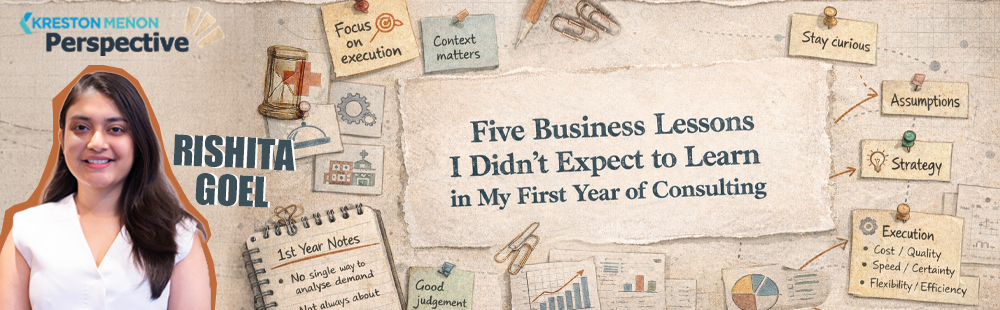
Five Business Lessons I Didn't Expect to Learn in My First Year of Consulting
 Rishita Goel, Associate Consultant - Kreston ME Consulting
A year into consulting, the reality felt different from what I expected.
I came in knowing the frameworks. I could build a financial model, structure a report, present findings. What I didn't fully grasp was how much of this work lives in the thinking before any of that. After a year at Kreston ME Consulting, working in industries across healthcare, pharma, manufacturing, F&B and childcare facilities, and closely with Freezone authorities on C-suite advisory work, here's what actually stayed with me.
1. There Is No Single Way to Analyse Demand
Most people default to market size. Total addressable market, done. But that's one lens out of many. In practice, demand analysis can go in multiple directions: addressable segments, penetration rates, customer categories, competitor density, growth trajectory or USP positioning. What I've come to appreciate at KMEC is how we sit together as a team before a project begins. Everyone brings their assumptions, their angle, their read on the business. No two consultants start from the same point, and that's not a flaw. The strength is in what comes out of that conversation, not in everyone arriving at the same answer.
2. The Best Businesses Are Not Always the Most Innovative
This one surprises people. We're mostly drawn to the disruptive, the breakthrough, the new. But across the projects I've worked on, the businesses that perform consistently are often the ones that simply execute better. Better service, tighter distribution, stronger client relationships, faster turnaround. It's not a glamorous observation, but execution outperforms innovation more often than the narrative suggests. If you're only looking for novelty in a feasibility study, you're likely missing the more important story.
3. Small Assumptions Create Large Differences in Outcomes
This became clear early. Two consultants working on the same business can produce very different projections, not because one is wrong, but because their starting assumptions diverge. A slight variation in growth rate, a different read on customer conversion, a different view on cost absorption, and by year three the numbers look like two separate businesses. The model is only as honest as the assumptions feeding it. Which is why the assumptions conversation almost always matters more than the model itself.
4. The Hardest Question Has Nothing to Do with the model
People assume the hard part of a business plan is the financial model. It isn't. The hard part is answering: why will customers choose you? Everything else follows from that. The spreadsheet comes after the thinking, not before it. In client-facing work, this is where most of the real friction lives. Owners often know their numbers well but struggle to articulate their competitive position in a way that holds up under pressure. Helping them work through that is where the advisory value actually sits.
5. Most Decisions Are Trade-offs, Not Answers
Growth versus profitability. Cost versus quality. Speed versus certainty. Flexibility versus efficiency. These aren't problems to solve cleanly. They are tensions to navigate. A large part of consulting, especially at the advisory level, is helping clients understand what they are actually choosing between. There is rarely a perfect answer. There is usually a more informed one.
One more that cuts across all the above: data helps, but context explains. Two companies can show similar numbers and live in completely different realities. The numbers tell you what happened. Context tells you why. Without that why, the analysis is incomplete, no matter how clean the model looks.
One year, multiple industries, dozens of conversations with business owners, operators, and decision-makers. The clearest thing I can say is this:
It's never just the numbers. It's what led to those numbers.