.svg)


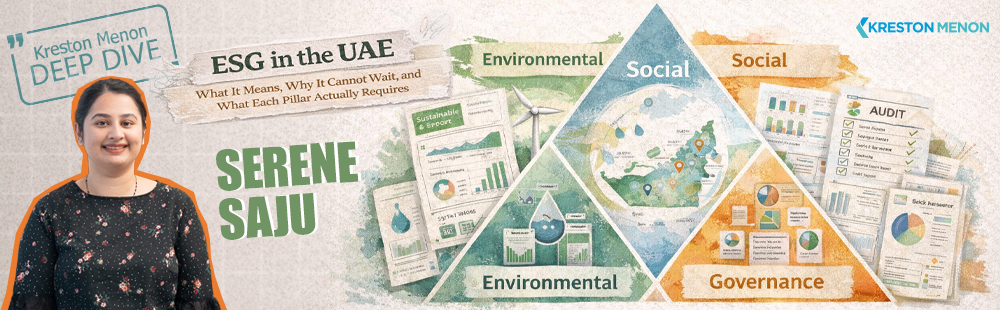
ESG in the UAE — What It Means, Why It Cannot Wait, and What Each Pillar Actually Requires
 Serene Saju, Audit Manager - Kreston Menon
ESG is one of those terms that arrives in a boardroom as an acronym and leaves a question: what does this mean for us, and why are we being asked about it now?
In the UAE, no blanket ESG mandate currently applies to most private businesses. Yet companies across sectors are finding ESG criteria embedded in financing processes, supply chain qualification, and investor due diligence — often before they have begun any formal ESG preparation. The Federal Decree-Law No. (11) of 2024 on the Reduction of Climate Change Effects formalizes a direction of travel that was already shaping commercial reality. The law is not a starting gun. The race has been under way for some time.
The Misconception That Is Costing UAE Businesses
The most common reason UAE businesses give for deferring ESG work is straightforward: there is no specific law requiring it yet. That reasoning is understandable. It is also structurally flawed.
ESG requirements do not travel exclusively through domestic regulation. They travel through counterparties. A family-owned manufacturer in Dubai supplying a European retailer will encounter ESG criteria in the retailer's vendor qualification process — regardless of what UAE law requires. A mid-sized firm seeking growth capital from a GCC sovereign fund or European private equity house will face ESG due diligence as a standard component of the investment process. A contractor bidding on infrastructure linked to the UAE's net zero commitments will find sustainability standards embedded in procurement criteria.
In each case, the obligation arrives from a commercial relationship, not a government circular. And that counterparty's requirements do not adjust to the UAE's domestic regulatory timeline.
The second misconception is scale: that ESG is a large-company concern. It is not. The obligation is triggered by the existence of relevant counterparties — investors, lenders, international customers — not by revenue thresholds or headcount. A business that engages in cross-border transactions or seeks international financing is already within scope, regardless of its size.
What ESG Is — In Plain Terms
ESG stands for Environmental, Social, and Governance. It is a structured framework for measuring how a business manages risks and creates value across three dimensions that financial accounts alone cannot capture. What distinguishes ESG from a general commitment to responsible practice is that it is measurable, comparable across companies and time periods, and increasingly subject to independent verification. Affirming that the business behaves responsibly is not sufficient. ESG frameworks require that claim to be evidenced with data.
Each of the three pillars poses a specific question to the business. Together, they form the basis of the due diligence assessment that a growing number of UAE businesses' most important counterparties are already conducting.
E — Environmental
The Environmental pillar asks: how does your business affect the natural environment, and how does environmental change affect your operations?
In practice, this covers greenhouse gas emissions across Scope 1 (direct, from owned sources), Scope 2 (indirect, from purchased energy), and increasingly Scope 3 (value chain); energy consumption and the proportion from renewables; water withdrawal and discharge; waste generation and management; and the business's exposure to physical climate risks — extreme heat, flooding, water scarcity — and transition risks arising from the global shift to a low-carbon economy.
For UAE businesses, the Environmental pillar is not abstract. The country records summer temperatures above 45 degrees Celsius, is among the highest per-capita energy consumers globally and faces structural water scarcity. Physical climate risk is a present operational condition, not a future projection. International counterparties — particularly European investors and customers subject to mandatory climate disclosure — apply this lens directly to UAE suppliers and investees. A business that cannot quantify its energy use or estimate its carbon footprint is increasingly difficult to finance, insure, or partner with.
A credible starting position requires: a documented inventory of energy consumption and Scope 1 and 2 emissions, calculated using an accepted methodology such as the GHG Protocol; an assessment of the physical climate risks most material to the business's sector and location; and a time-bound reduction target, however modest, that demonstrates awareness and direction.
S — Social
The Social pillar asks: how does your business treat the people it depends on?
This covers workforce health and safety — incident rates, fatality records, near-miss systems; labour practices including working hours, wage levels, and the treatment of migrant and contract workers; diversity and inclusion across gender, nationality, and level; employee development and retention; supply chain labour standards; and the company's broader impact on the communities it operates in.
For UAE businesses, the Social pillar intersects directly with domestic policy. The Emiratisation agenda — formalized through NAFIS and quota obligations on private sector employers — is a Social metric. Businesses that cannot demonstrate progress on Emirati representation are simultaneously out of step with national policy and ESG expectations. The UAE's large migrant worker population is subject to increasing international scrutiny: the country has made meaningful labour reforms, but ESG frameworks require evidence of compliance rather than reference to the existence of regulation. A UAE company that applies high internal standards but procures from suppliers with poor labour practices carries ESG exposure regardless of its own conduct.
A credible starting position requires: structured workforce data — headcount by gender, nationality, and employment category — compiled from HR systems; health and safety metrics in reportable format; documented Emiratisation rates against NAFIS targets; and a supplier code of conduct with evidence of how compliance is monitored.
G — Governance
The Governance pillar asks: how is your business directed, controlled, and held accountable?
This covers board composition and independence; audit and risk committee structure; executive remuneration disclosure; anti-bribery and corruption policies and their enforcement; whistleblower mechanisms; tax transparency; and whether ESG risk sits formally within the board's oversight remit.
For family-owned and privately held businesses — which represent a significant portion of UAE commercial activity — governance is often the pillar requiring the most deliberate attention. Many such businesses are well-managed, but their governance structures were designed for internal accountability rather than external scrutiny. When a business seeks external financing, enters a joint venture with an international partner, or prepares for a transaction, those structures are tested in ways they were not built for. ESG due diligence specifically probes the mechanisms that protect external stakeholders — and a governance framework built for owner-manager convenience will not survive that examination without enhancement.
A credible starting position requires: documented board structure with demonstrable independence of oversight functions; a code of conduct or ethics policy communicated to all employees; a functioning whistleblower channel; and formal board-level oversight of ESG risk — not delegated entirely to management.

To put this into perspective
A UAE-based food and beverage company with strong regional growth and a well-recognized brand enters discussions with a global private equity fund about a minority investment. The fund's ESG assessment runs across all three pillars simultaneously.
On Environmental: the company has no structured record of energy consumption or emissions. Its cold-chain logistics — a significant source of Scope 1 emissions — has never been assessed. The fund requires a baseline emissions assessment and transition risk review before closing.
On Social: the health and safety record is clean, but incident data is held informally and has never been compiled in reportable form. The Emiratisation rate is below the sector's NAFIS target. The fund requires a formal H&S data system and a documented Emiratisation plan as investment conditions.
On Governance: the board includes three family members and one independent director. There is no audit committee. A code of conduct exists but has not been reviewed in four years, and there is no whistleblower mechanism. The fund requires two additional independent board appointments and a formal audit committee before closing.
In each pillar, the company's underlying performance is reasonable. The gaps are structural and documentary — a lack of systems, formality, and evidence. The investment closes, but with a twelve-month ESG remediation plan as a condition, at material cost to management time and advisory fees. The lesson is consistent across all three pillars: ESG is not primarily about changing what a business does. It is about building evidence to demonstrate what it already does well.
Why Starting Now Is the Commercial Decision
Building ESG capability — emissions inventories, data systems, governance structures, disclosure frameworks — takes time when done properly. It also requires internal buy-in, which is substantially easier to build when the conversation is strategic and forward-looking rather than reactive and deadline-driven.
Businesses that begin now can calibrate the effort to their scale. A proportionate first step — a baseline assessment, three to five material topics identified, a data collection program for the priority indicators — is not an overwhelming exercise. It is a manageable one. The same exercise, compressed into a timeline set by a financing condition or a supply chain audit deadline, is a significantly more expensive and disruptive one.
The UAE Federal Decree-Law No. (11) of 2024 on the Reduction of Climate Change Effects is not the end of the regulatory story. It is the beginning of a formalized one. Early adopters of the legislative intent will hold a strong competitive edge over firms that wait for the official circular.
The Core Insight
ESG is not a large-company issue, not a future regulatory problem, and not a Western concept being imposed from outside. It is a commercial reality — present in the decisions of investors, lenders, and supply chain partners that UAE businesses are engaging with today. Each of the three pillars asks a question that any serious external stakeholder will eventually put to your business. The only variable is whether you have a prepared answer.
A proportionate starting point should include:
- Environmental: establish a Scope 1 and Scope 2 emissions baseline using the GHG Protocol; identify the three physical climate risks most material to your sector and UAE location
- Social: consolidate workforce data by gender, nationality, and category; compile H&S incident records in structured form; document your Emiratisation position against NAFIS targets
- Governance: assess board independence and committee structure; review and refresh your code of conduct; confirm a functioning whistleblower channel; bring ESG risk formally within board oversight
- Across all three: identify which stakeholders — investors, lenders, customers — are most likely to ask ESG questions, and assess your current ability to answer them with evidence rather than assertion
ESG readiness is not determined by the existence of a domestic mandate. It is determined by the existence of a counterparty who requires it.