

Japan and the United Arab Emirates stand today at a pivotal moment in their economic relationship. On one side, Japan is entering a new phase of confident economic renewal, industrial reinvestment, and global engagement. On the other, the UAE has rapidly developed into one of the world’s most dynamic hubs for capital formation, holding structures, and cross-border corporate expansion.
These two economies, one built on technological depth and institutional stability, the other on visionary diversification and global connectivity, are increasingly converging into a powerful investment corridor. For investors in Dubai as well as multinational groups across the GCC, Japan has re-emerged as one of the most compelling destinations for long-term growth.
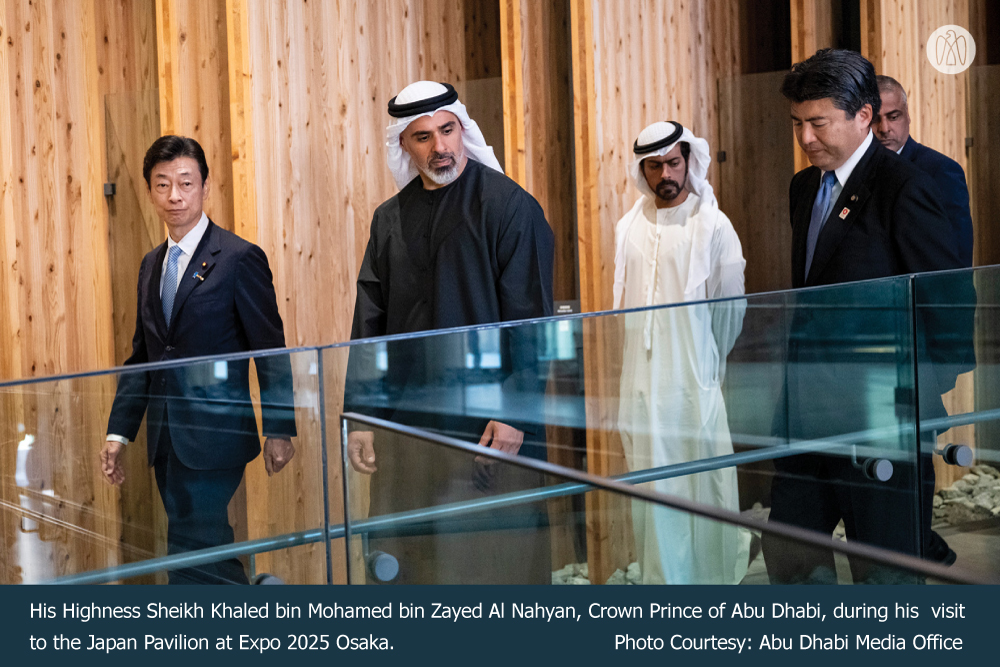
This article explores the forces behind Japan’s investment momentum, the strategic advantages of the popular Dubai–Singapore–Japan structure, and a practical case from the Osaka World Expo 2025 demonstrating how UAE businesses can thrive in Japan with the right partners.
Japan 2025: A Stable, High-Value Market Entering a New Cycle
Japan’s economic renewal is driven by several foundational strengths that matter deeply to international investors:
A Growing, Balanced Economy
Japan’s GDP in 2025 is forecast to grow around 1.1%, supported by moderate inflation consistently above 2%, a sign of healthy demand and policy stability. Corporate earnings have strengthened, and capital markets have seen broad-based optimism over the past three years.
Tokyo: One of the World’s Most Powerful Economic Cities
According to figures presented at our recent Kreston World Conference in Tokyo, the capital city alone represents:
• USD 1.01 trillion GDP,
• USD 6.5 trillion in market capitalization, and
• USD 15.2 trillion in household financial assets.
The Tokyo Metropolitan Government also highlighted its position as:
• #1 globally in the City Resilience Index,
• #2 worldwide in foreign company headquarters,
• #3 worldwide in the Global Power City Index.
These indicators reflect a stable, highly globalized ecosystem where international businesses can expand with confidence.
Strategic Sector Expansion
Japan’s industrial strategy emphasizes long-term investment in:
• Semiconductors (major TSMC and Rapidus projects),
• Green transformation & hydrogen,
• AI, automation, and robotics,
• Advanced mobility and defense manufacturing,
• Digital infrastructure and data centers.
For UAE investors accustomed to deploying capital into scalable, future-ready sectors, Japan provides not only a large market but also an innovation platform with government-backed stability and predictable tax policy.
Why UAE Investors Are Increasingly Looking Toward Japan
The UAE and Japan share a long history of economic cooperation, but 2024–2025 brought a noticeable increase in two-way investment. Several trends explain this momentum:
1. Complementary Strengths
• The UAE provides capital mobility, a pro-business regulatory environment, and strategic location.
• Japan offers advanced manufacturing, technological depth, and institutional reliability.
Together, they form a natural fit for multinational companies looking to scale globally.
2. Growing Cultural and Business Connectivity
In November 2025, the Governor of Tokyo delivered a keynote address at the Kreston World Conference, an important symbol of Japan’s commitment to deeper engagement with global investors and particularly with Middle Eastern partners.
3. Demand for High-Quality Project Delivery
Japan continues to attract large-scale events and international projects, increasingly relying on specialized operators from the UAE and beyond. This strengthens the flow of expertise, goods, services, and capital.
A Popular Investment Route: The Dubai–Singapore–Japan Structure
For investors entering Japan, one of the most efficient, tax-optimized and widely accepted approaches is a three-tier holding model, often structured as follows:
1. Dubai Holding Company
Dubai serves as an excellent anchor for global wealth and investment platforms because of:
• 0% tax on dividends and capital gains for qualifying entities,
• Free repatriation of profits,
• Strong banking and substance infrastructure,
• Excellent global mobility for capital and management.
2. Singapore Regional Subsidiary
Singapore provides the operational and treaty benefits needed to manage the Asia-Pacific region:
• 17% corporate tax with incentives reducing effective rates for many groups,
• Tax treaty with Japan reducing withholding tax on dividends to 5% and on royalties/interest to 10%,
• Strong recognition by Japan’s NTA in terms of substance and transfer pricing transparency.
3. Japanese Operating Entity (KK or GK)
This entity conducts the commercial activity in Japan – sales, hiring, contracts with access to:
• Local subsidies for high-value industries,
• Startup and foreign entrepreneur programs,
• Preferential zones offering regulatory and administrative support.
Why this structure works: It balances tax efficiency, regulatory predictability, and commercial credibility, making it ideal for holding, financing, IP management, and regional command-center functions while keeping Japan operations compliant and locally respected.
Case Study: A Dubai-Based Global Events Leader at the Osaka World Expo 2025
In 2025, Kreston ProWorks Japan had the privilege of supporting a prominent Dubai-headquartered company specializing in the management of global mega-events including Olympic Games, World Cups, and World Expos.
The Challenge
For the Osaka World Expo (April–October 2025), the company was responsible for operating national pavilions for more than 10 countries, requiring the hiring and management of over 400 staff in Japan. The project required:
• Rapid, compliant onboarding of multilingual teams,
• Complex payroll and HR operations,
• Direct coordination with government, pavilion commissioners, and international sponsors,
• Full employment and tax compliance under Japanese law.
Our Role
As their local partner, Kreston ProWorks provided:
• Full operation of the Project holding Co.
• Employer-of-Record (EOR) services,
• Payroll, HR, treasury and tax compliance,
• Corporate governance support,
• Hands-on operational guidance during the full duration of the event.
The successful delivery demonstrated that UAE expertise + Japanese execution capability create a highly competitive combination for large-scale, international projects in Japan.
Kreston ProWorks Japan: Your Gateway to the Japanese Market
For over 18 years, Kreston ProWorks has served as a full-service in-bound advisory firm for foreign-owned companies in Japan. From Tokyo and Honolulu, our team supports clients through:
• Market-entry and corporate establishment
• Accounting, tax, and compliance
• HR, payroll, and Employer-of-Record solutions
• Transfer pricing and permanent establishment advisory
• Banking, governance, and regulatory support
• Other Advisory Services
As members of Kreston Global, we work seamlessly with our colleagues in Dubai and Singapore to establish necessary relationships and build international structures that are strategically and fiscally optimized while remaining fully compliant in Japan.
Our approach is simple: Local knowledge. Global coordination. Seamless execution.
Looking Ahead: The UAE–Japan Corridor in 2026 and Beyond
The next decade will be defined by stronger Asia–Middle East connectivity. Japan’s focus on technological resilience, industrial independence, and sustainability aligns closely with the UAE’s ambitions to become a global nexus for capital, innovation, and logistics.
For private investors, family offices, and corporates in Dubai, Japan represents:
• A safe jurisdiction for large, long-term investments
• A sophisticated market with rising demand for foreign expertise
• A global hub for manufacturing, technology, and green innovation
With the right structure, advisory team, and local partner, Japan becomes not just a market to enter—but a strategic base for global expansion. At Kreston ProWorks Japan, we stand ready to support investors on this journey and to strengthen the bridge between Dubai and Tokyo for years to come.