
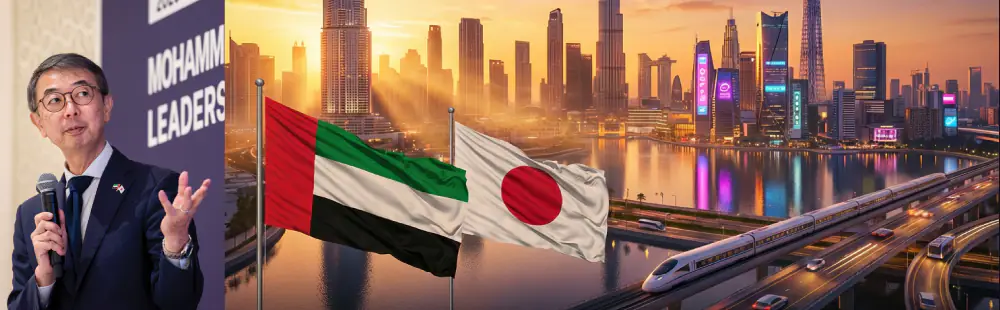
Over the last decade, the relationship between Japan and the United Arab Emirates (UAE) has witnessed remarkable growth over the years, evolving into a robust partnership characterized by mutual respect and collaboration.
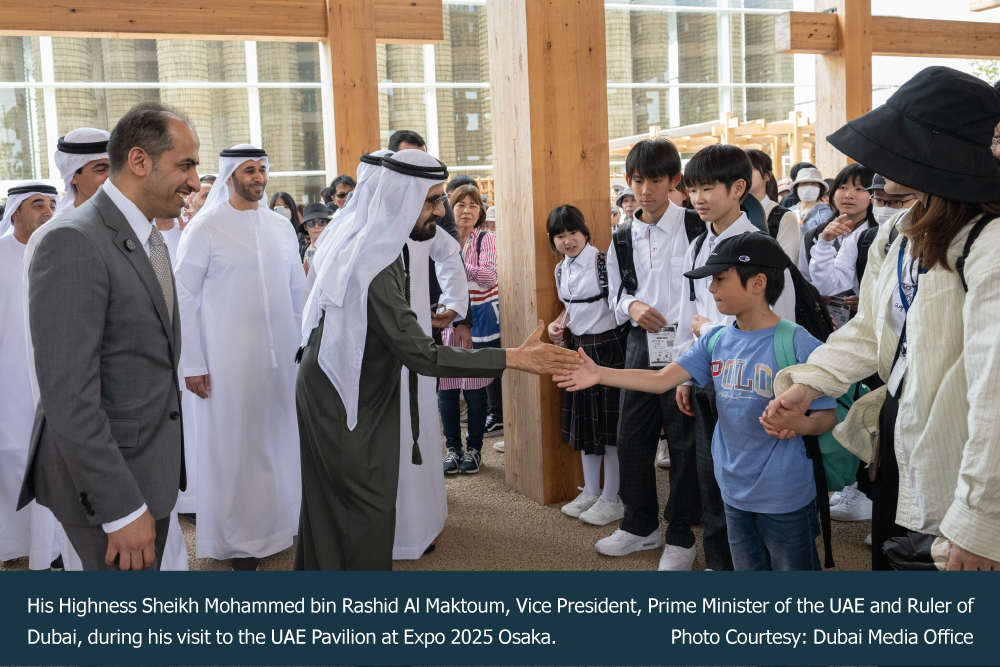
Through the World Expos, the UAE and Japan have shared a historically deep relationship. Fifty-five years ago, Abu Dhabi participated in its first Expo in Osaka in 1970. Expo 2020 Dubai was a defining moment in the UAE’s global engagement. Having taken the baton from Dubai, the Osaka-Kansai Expo under the theme “Designing the Future Society for Our Lives.” was successfully concluded. Expo 2025 became a proving ground for shared human progress for both countries.
While the Japan Pavilion at Expo 2020 Dubai achieved great success, winning a gold award for design, the UAE Pavilion at Expo 2025 Osaka, which featured many palm trees, attracted over 5 million visitors, won the BIE Bronze Award and showcased innovation and culture, thereby reinforcing the UAE’s vision of global collaboration. The Expos in both the UAE and Japan enabled the two nations to rediscover themselves, providing a unique opportunity to showcase technological, cultural and sustainable advances in addressing global challenges.
As the Consul-General of Japan in Dubai, I have had the privilege of providing an overview of the current state of our partnership. I have also highlighted concrete examples of business and economic collaboration and shared my perspectives on future opportunities for cooperation.
Japan-UAE relations are anchored in shared interests and common goals, including economic diversification, innovation, and sustainable development. The UAE’s strategic location at a global crossroads of the Middle East and Africa is of great importance, and Japan’s technological expertise and economic strength provide a solid foundation for collaboration.
One of the most significant recent developments in our bilateral relations is the ongoing negotiation of the Japan-UAE Economic Partnership Agreement (EPA). Once concluded, the agreement is expected to enhance trade and investment, thereby fostering economic growth and job creation in both countries.
Over 300 Japanese companies have already established a presence in Dubai, with many using it as their regional headquarters for the Middle East and Africa. These companies have contributed to iconic projects such as the Dubai Metro, the Jumeirah Monorail, and Terminal 3 at Dubai International Airport, showcasing the depth of our commitment to the development of Dubai.
Japanese companies have played a significant role in shaping Dubai’s urban landscape. Their cooperation extends beyond infrastructure to encompass crucial environmental projects. For instance, they are actively developing decarbonization initiatives and sustainable infrastructure, such as the Warsan Waste Management Centre. This facility generates electricity from waste heat and has the world’s largest processing capacity of 5,660 tons per day.
Another example of a successful Japanese company’s contributions is the UAE’s vital water infrastructure, which relies heavily on advanced Japanese desalination pumps. Representing the cutting edge of innovative and environmentally conscious technology, these pumps ensure a consistent supply of water to homes, businesses, and critical facilities throughout Dubai and the wider UAE.
The UAE has long been a crucial energy partner for Japan, supplying nearly 40% of our crude oil. However, our collaboration is now expanding beyond traditional hydrocarbons to encompass exciting opportunities in renewable energy and decarbonization. Japan’s expertise in these fields aligns with the UAE’s commitment to renewable energy and complements the UAE’s ambitions for a sustainable energy future. In Sharjah, a joint project with SNOC to capture and store CO2 underground (CCS) is progressing well. These projects demonstrate Japan’s commitment to supporting the UAE’s Vision 2031 and beyond.
Looking to the future, technology and innovation are promising fields in which to deepen our partnership. The UAE’s commitment to establishing itself as a hub for technology and innovation aligns with Japan’s expertise in artificial intelligence, robotics, and digital transformation. Collaborative initiatives in these areas can drive economic growth and enhance competitiveness. For example, Professor Hiroshi Ishiguro’s groundbreaking work in robotics as demonstrated through in a remote avatar-based sales pilot with customers in Dubai, is a prime example of this.
Japan and the UAE have also made significant strides in the field of space cooperation. As part of the Emirates Mission to the Asteroid Belt (EMA), the UAE Space Agency plans to launch the “Mohammed Bin Rashid Explorer” spacecraft aboard a Japanese MHI H3 rocket in early 2028. This collaboration underscores the potential for joint exploration and innovation in space technology and will further strengthen the bilateral ties.
Last but not least, cultural exchange plays a vital role in fostering closer ties between Japan and the UAE. Promoting inbound tourism, alongside cultural exchange programmes, can strengthen people-to-people bonds and enhance mutual understanding.
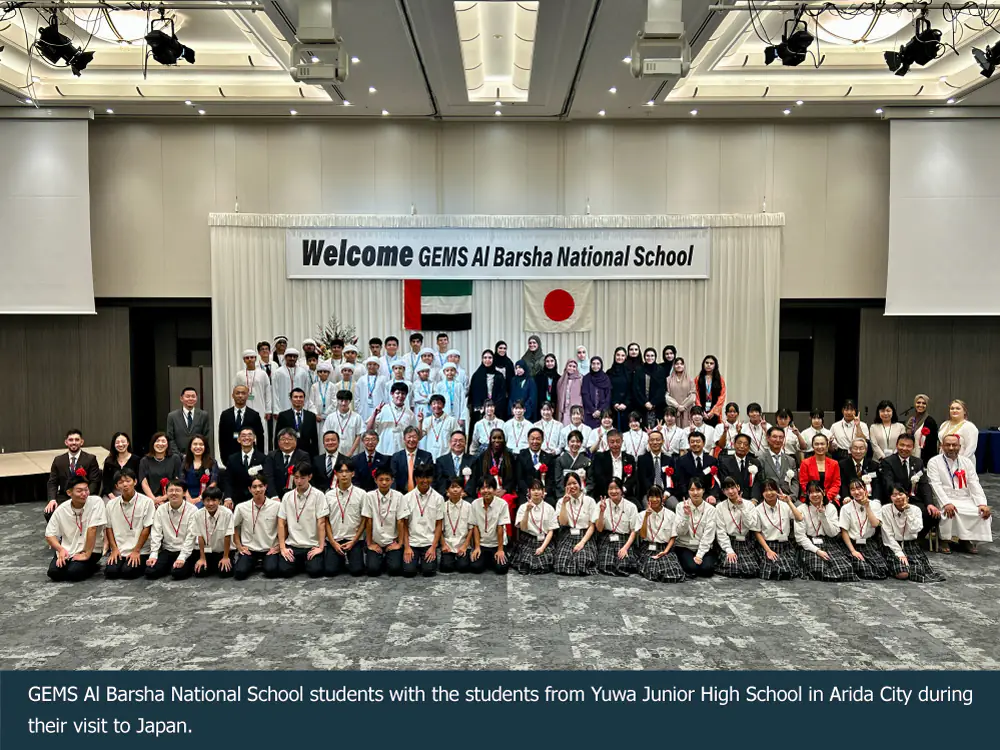
In 2025, high school students from Tokyo and junior high school students from Arida City in Wakayama Prefecture visited Dubai for exchange programmes. Furthermore, the MBR Leadership Programme saw future leaders from Dubai visit Japan.
Such exchanges will cultivate the new generation of leaders who are ready to address global challenges. In 2025, the UAE and Japan eased visa restrictions for each other’s citizens, allowing visa-free short stays of up to 90 days. We hope that exchanges between citizens will continue to be further promoted.
The partnership between Japan and the UAE is a testament to the power of collaboration and shared vision. By leveraging our respective strengths and exploring new avenues for cooperation, we can build a prosperous, innovative and sustainable future. As the Consul-General of Japan in Dubai, I am committed to supporting and advancing this partnership to ensure that it continues to thrive for the benefit of our two nations and their peoples. Addressing today’s shared global challenges requires us to deepen our collaborative efforts. Together, we can achieve remarkable milestones and set new standards for international cooperation in the 21st century.